Genealogie Bos

This is my English-language Genealogy & Ancestry Blog.
(Mijn Nederlandstalige blog is genealogiebos.blogspot.nl).
Showing posts with label WWII. Show all posts

22 Aug 2024

Brigg and Bastin sisters

Two sisters, Olga (15) and Irene (8½) Bastin, died in a war accident on 13 October 1944 in Heerlen, The Netherlands. They were buried on the seventeenth. 

Veritas, 17-1-1944

The father of Olga and Irene is Johannes Franciscus Hubertus (“Jean”) Bastin. He was born on 9 September 1896 in Mheer, Limburg, The Netherlands, as illegitimate son of Gertrudis Bastin (1871-1943). His birth was registered by Elisabeth Schreurs (1849-1925), Gertrudis' mother.
Olga and Irene's mothers are Jean's subsequent wives, the sisters Hubertine Elise Marianne Brigg (1893-1930) and Elise Hubertina Joanna Brigg (1901-1949). They are the two surviving daughters of Bernardus Brigg (1862-1922) and his wife Maria Joanna Hubertina (“Marie”) Duchateau (1865-1965). Marie and Bernardus and married on 26 January 1893 in Amsterdam. Although Marie Duchateau died at the age of 100, her daughter Hubertina died at the early age of 36, while the other, Elise, died at the age of 48.

Limburger Koerier, 20-5-1930

After the deaths of his daughters Olga Jeanne Augusta Gertrude and Irene Maria Elise Ernestine in 1944, Jean had 4 remaining children: Yvon (by his first wife), Roger, Cyrille and Gaston.

Sources: WieWasWie.nl, Delpher.nl, AlleLimburgers.nl, Rijckheyt.nl, Archieven.nl, Archief.Amsterdam.

29 Aug 2021

Goldchen Lewertoff left for Hamburg

Goldchen Lewertoff was born on 18 April 1854 in Lübeck in Germany. She married merchant Hartog Stoppelman in May 1896 in Delfzijl near Groningen in The Netherlands. Hartog was born on 1 April 1863 in nearby Nieuwe Pekela. His parents were merchant Arond Stopplman (1827-1891) and his wife Hendrijetta Meiberg (1828-1905).

In the spring of 1908 Hartog and Goldchen left Lübeck for Rotterdam in Holland. Early 1909, however, Goldchen left for Hamburg in Germany. Soon thereafter Hartog left for Sneek in the North of The Netherlands. On May 19th, he was sentenced to 14 days of imprisonment. By August Hartog was back in Rotterdam.
Hartog's sister Hendeltje Stoppelman (1844-1914) had married Israël van Coeverden. Their daughter Roosje was born on 6 April 1876 in Coevorden and gave birth in Rotterdam on 15 June 1899 to an illegitimate daughter named Heintje. Heintje lived for a while with her great-uncle Hartog in Rotterdam.

With his wife staying in Germany, Hartog Stoppelman decided to file for a divorce. It was approved by the court in Rotterdam on 15 October 1917. The divorce was registered on 22 March 1918 in The Hague.

Nederlandsche Staatscourant, 12-9-1918

On 12 July 1922 in Rotterdam Hertog Stoppelman, aged 59, finally remarried. His bride was 43-year-old Hester van Blankestein. She was born on 31 October 1862 in IJsselmonde, south of Rotterdam. Her parents are Barend van Blankestein (1831-1893) and Chonetta van de Waal (1837-1906).
At the age of 42, on 8 November 1911 in Rotterdam, Hester had married 52-year-old Jacob Schustirowitz. Jacob was widower of Rosa Galoen (1863-1910) whom he had married in 1884 in Groningen. He was born on 9 July 1859 in Sebastopol in Russia as son of Izaak Schustirowitz and Anna Macen. Jacob had died on 5 June 1918 in Rotterdam, aged 58.

At the age of 72, Hertog Stoppelman died in Rotterdam on 27 June 1935. His widow, Hester van Blankenstein, died around 15 October 1942 in Auschwitz concentration camp in Poland. Her death was finally registered in Rotterdam in 1951.

Sources: WieWasWie.nl, StadsArchief.Rotterdam.nl, Delpher.nl, en.Wikipedia.org.

4 May 2021

Johannes George Vrolijk (1920-43) in WWII

Johannes George Vrolijk
(1920-1943)

Johannes George Vrolijk was executed in the Tegel area of Berlin, Germany, on 4 June 1943, aged 23. He had been part of a World War II resistance group known as the "Strijkelgroep". In the spring of 1941, 47 men and women of this group were arrested by the Nazi's. Johannes George Vrolijk was one of the 32 people executed on 4 June 1943. The others were send to prison camps. Just 3 women and 1 man of the group survived the horrors of the German concentration camps.

Johannes George Vrolijk was born on 30 April 1920 in Zwijndrecht, Holland, as eldest son of Johannes George Vrolijk (1888-1983) and his wife Baartje den Hoed. His paternal grandparents were Johannes George Vrolijk (1862-1949) and Neeltje Bos (1860-1936). Neeltje is a granddaughter of my ancestor Cent Leenderts Bos (±1787-1869). In the paternal line Johannes George Vrolijk descends from a Jakob Fröhlich of German origin.

Sources: OorlogsGravenStichting.nlWieWasWie.nl, Stijkelgroep.nl.

8 Apr 2021

Sniper Lubbert Bos

The muster books of the Royal Netherlands East Indies Army (KNIL) mention Lubbert Bos in 1916. I found Lubbert Bos employed in Indonesia as fusilier and sniper in 1919. His height was 175 cm, and he had tattoos on both arms. On December 8, 1921, he was reported as “missing”, but by January 5, 1922, he was back. In August he was again “missing”, and by September 10 he was back.
Lubbert Bos returned from Indonesia with the SS Rembrandt, arriving in Amsterdam on April 19, 1923.

Parents' names, date of birth, and description. Career notes

4 May 2020

Barend Booi (21) died in 1947 in Indonesia

Following World War II, the Royal Netherlands East Indies Army (KNIL) launched a military campaign in 1947 to try to re-establish Dutch control of Indonesia. The infantry regiment 4-11 departed on 5 February 1947 on the "Johan van Oldebarneveldt" for Indonesia, where it arrived on 5 March 1947. The regiment consisted of young boys recruited for obligatory military service, among them was Barend Booi. 
While fighting 4 kilometers west of Mangoenreja, Indonesia, Barend Booi died on 22 November 1947, aged 21. The death of Barent Booi was registered on 12 April 1948 in Dubbeldam, Holland. The Dutch military efforts to re-establish their colony failed, and The Netherlands recognized Indonesian independence on 27 December 1949. 
Source: oorlogsgravenstichting.nl

In Dubbeldam Barend Booi was born on 25 February 1926. His parents are Abraham Booi and Wilhelmina Maria van der Burg. They had been married on 28 November 1918 in Dordrecht, Holland. Wilhelmina Maria van der Burg had been 23 years old, and was born in The Hague. Her parents are Johannes Franciscus van der Burg en Maria Adriana Philip.
Barent's paternal grandmother, Barendina Boertje, was born on 15-7-1858 in Wieldrecht, Holland, and was buried in Dubbeldam on 5 September 1942, 84 years old. She had been married on 9 May 1877 in Dubbeldam to Abraham Booij sr. He was born on 17 September 1854 in Dubbeldam and died there on 16 November 1934.
Barent's paternal great-grandparents were Joris Booi (1827-1906) and his first wife Marigje Naaktgeboren (1831-1864). Joris is a son of Nicolaas “Claas” Booij (1787-1847) and Johanna Piere (1796-1854). Claas is a son of my ancestors Joris Booij (1753-1813) of Dubbeldam and his wife Hendrina Sprong (1759-1832).

Signatures of Barent's parents

Sources:
wiewaswie.nl, regionaalarchiefdordrecht.nloorlogsgravenstichting.nl, www.indie-1945-1950.nl4en5mei.nlvomi-nederland.nl/monumentenlijstvangevallenen.nl.

2 May 2019

Henri Gerrit Booij (1907-1944) from Rotterdam was buried in Changkai

Henri Gerrit Booij was born on 2 July 1907 in Rotterdam. His parents are Hendrik Booij and Jannetje de Wilde. His paternal grandparents are Gerrit Booij (1837-1882) and Bregtje de Waal. His paternal great-grandparents are Jacob Booij (1785-1866) and his third wife Niesje Beets (1810-1882) who were living in Ilpendam, Holland. The paternal great-great-grandparents of Henri Gerrit are Gerrit Jacobsz. Booij (1757-1828), Eegje Jans Dekker (1763-1820), Sijmon Jansz. Beets (±1767-1817) and Krelisje Bos (1776-1848).

When Henri Gerrit Booij was 21 years old, his father Henri Booij died on 1 June 1929, aged 52, in Hillegersberg (now part of Rotterdam). He had been born on 30 May 1877 in Buiksloot, Holland, and had been working as a waiter. Henri's widow, Jannetje de Wilde, was born on 19 March 1873 in Amsterfoort, Utrecht area, The Netherlands. They had been married on 7 March 1901 in Amsterdam. An overview of their younger children and birth dates is shown in the image below. 

Henri Gerrits Booij with his parents and younger siblings
At the age of 31, Henri Gerrit Booij was married on 23 November 1938 in Rotterdam to Helena Johanna Maria Verbakel, aged 29, born in Rotterdam. She was born on 7 March 1909 in Rotterdam as the eldest daughter of Wilhelmus Jacobus Verbakel (1879-1964) and Johanna Gerarda Visser. At some point the couple traveled to Indonesia.

POW Camp Card for Henri Gerrit Booij
In Indonesia Henri Gerrit Booij was working as a hotel clerk, probably in Nongkodjadjar on Java. He was described an infantry sergeant for the Royal Netherlands East Indies Army (KNIL) when he was captured by the Japanese on Java on 10 March 1942. He was transferred to the main Java Prisoner Of War (POW) Camp on 1 November 1942, and interned. He was transferred to the Thai No. 4 Branch Camp 7855 on 29 January 1943. Often, prisoners in the Thai POW Camps were forced by the Japanese to work on the Burma Railway between Nong Pladuk in Thailand and Thanbyuzayat in Burma (now Myanmar). Henri Gerrit Booij died in the No. 4 Branch Camp on 11 February 1944. He was buried in Chungkai.

8 Jan 2018

Leendert Arend Jan Bos (1918-43) and the Burma Railway

Leendert Arend Jan Bos was born on October 21, 1918, in Klaaswaal in Holland. Klaaswaal is located in the area where my Bos ancestors have lived through the ages, but Bos is a common name in The Netherlands, and I have no clue who his parents were. Leendert could be either a distant relative, or no relation at all. His mother's surname was Dirkje and she lived at the Oud Kromstrijensedijk in Klaaswaal.

Japanese internment card 
During the war, when he was in his 20s, Leendert was an airplane mechanic in the Royal Netherlands East Indies Army (KNIL). On March 9, 1942, Leendert was captured by the Japanese. He was interned in a Java Pow Camp on August 15, 1942. In 1943 Leendert was forced to work on the Burma Railway. Begun in October 1942 and completed on 16 October 1943, the Burma Railway stretched 415 kilometres between Nong Pladuk in Thailand and Thanbyuzayat in Burma (now Myanmar). It was built by order of Japan during World War II to support its forces in the Burma campaign. 
  
The terrain the railway crossed made its construction very difficult. Hellfire Pass in the Tenasserim Hills was a particularly difficult section of the line to build due to it being the largest rock cutting on the railway, coupled with its general remoteness and the lack of proper construction tools during building. The most famous portion of the railway is Bridge 277, 'the bridge over the River Kwai', which was built over a stretch of river.

About 180,000 Asian labourers and 60,000 Allied prisoners of war (POWs) worked on the Burma Railway. Of these, around 90,000 Asian labourers and 16,000 Allied POWs died as a direct result of the project. The dead POWs included 6,318 British personnel, 2,815 Australians, 2,490 Dutch, about 356 Americans and a smaller number of Canadians and New Zealanders.

One of them was Leendert Arend Jan Bos. He fell ill on March 21, 1943, and died on June 19, 1943, around 15:00 in a hospital in the Thai POW Camp at Tha Makham Village in Kanchanaburi County in Thailand. He had suffered from beri-beri due to a vitamin B1 shortage. Leendert Bos is buried on the Kanchanaburi War Cemetery. 

Nieuwsblad voor de Hoeksche Waard en IJselmonde, 9-10-1945

See also: GaHetNa.nlThe Building of Hellfire Passerelijst.nl4en5mei.nl, Delpher.nl, NationaalArchief.nl.

18 Sept 2014

Treasure Chest Thursday - My Grandmonther's 1941 ID-card

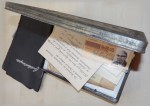
Recently I received a little "treasure chest" from my uncle Cees de Jong. Among many other papers pertaining my grandparents, it contained my maternal grandmother's wartime identity card:  

My grandmother's 1941 ID-card

This ID-card ("persoonsbewijs" in Dutch) was introduced in The Netherlands by the Germans during World War II in April 1941.


My Little Treasure Chest
I'd never seen a photograph of my grandmother before she was a bended little old granny, so this ID-card is a real "treasure" for me!