Genealogie Bos

This is my English-language Genealogy & Ancestry Blog.
(Mijn Nederlandstalige blog is genealogiebos.blogspot.nl).
Showing posts with label mariner. Show all posts

21 Feb 2025

Nollius Hajonides van der Meulen (1862-1907) drowned

The “SS Berlin” was a steel ship of 1775 tons, build for use on the ferry service from Harwich to Hook of Holland. On Thursday 21 February 1907, around 5 o’clock, a huge wave struck the ship, causing her to become impaled on the tip of the granite breakwater at the entrance to the New Waterway, west of Rotterdam. A Dutch lifeboat attempted to offer aid, but the rough seas rendered it impossible to approach the stricken vessel. Around 6 o’clock the ship broke in two, drowning the majority of the passengers. Later, 16 survivors were rescued, while 128 people had drowned.

Nederlandsche Staatscourant, 5-3-1907

One notable passenger who drowned was a King’s messenger, Mr. Herbert, travelling with diplomatic bags. Another victim was Hendrik Spijker of the Spyker car company. The main subject of this blog post, Nollius Hajonides van der Meulen, was also killed in this disaster.

Leeuwarder Courant, 25-2-1907

Nollius Hajonides van der Meulen was born on 7 July 1862 in Leeuwarden as eldest son of Pieter Hajonides van der Meulen (1835-1875) and Anna Gorter (1838-1918).
As an Adult, Nollius Hajonides traded in flax. At the age of 32, on 27 June 1895 in Menaldumadeel, Nollius Hajonides van der Meulen married 25-year-old Clasiena Cornelia Alma. She was born on 11 April 1871 as daughter of Margrieta Maas (1842-1916) and Hermanus Alma (1839-1915).

6 Feb 2023

Roelof Groenwold of Stavanger, Norway, married in Rotterdam, Holland

Roelof Groenwold was born around 1734 in Stavanger in Norway. He was first married on 29 Novmeber 1761 to Aaltje Aalberg. Aaltje was baptised in the Lutheran church in Rotterdam on 25 April 1745 with witnesses Andries Laurens Brandt and Maria Clawijn. Aaltje's mother is Johanna Kraaijwinkel (1707-1775) who was born in Gennep, Limburg, The Netherlands. Aaltje's father is Roelof Aalberg who originated in Göteborg in Sweden.
Aaltje was 5 times pregnant, and had 4 surviving children, when she was buried on 11 December 1771 in Rotterdam.

As a widower, Roelof Groenwold remarried on 5 May 1774 in Rotterdam. His bride was Anna Catharina Geertruij Westhoff, who originated in Gennep, like his first mother-in-law. Anna gave birth to 4 children, but her youngest daughter died after just a couple of weeks.

Roelof Groenwold was a skipper. With his ship “De Vrouw Carolina Johanna” Roelof Groenwold left for Smirna (İzmir in Turkey) in August 1786. In november 1786 he had arrived in Livorno. At the end of 1787 Roelof Groenwold is mentioned in a newspaper as having arrived in Smirna. In the afternoon of 30 June 1788 Roelof sailed from Hellevoetsluis, Holland, through "Het Hitsertsche Gat". In september he put his ship “De Vrouw Carolina Johanna” up for sale. The schip had a length of 31 meters, and a width of 9 meters. It was anchored in the Leuvehaven in Rotterdam.

Rotterdamse Courant, 18-9-1788

Roelof's son Laurentius Christian became a sailor like his father. At the age of just 16, on 17-6-1791, he boarded the ship for Indonesia. Sailing back from Batavia to the Cape the schip named “Gouverneur Falck” was wrecked on 18-2-1792, and all those on board were drowned, including Laurens Christian.

22 Sept 2020

The disappearance of Cornelia Stolk

The Cornelia Stolk in this story was born in Rotterdam on February 23, 1800. She was the second child of Abraham Stolk (1779-1833) and his first wife Cornelia Koppen. She had 6 further siblings, but some of them died young.
At the age of 19, Cornelia Stok was married on May 19, 1819, in Rotterdam to Hendrik Zwartbol. He was the only surviving son of Cornelis Zwartbol and Anna van den Hoek. Hendrik born in Charlois (now part of Rotterdam) on February 8, 1798. His eyes were blue and his hair and eyebrows were brown.
The couple had two daughters, both born in Rotterdam: Johanna Cornelia on October 30, 1819, and Cornelia Hendrika on July 30, 1821. They grew up without a mother.
Relatives and acquaintances mentioned in a statement, drawn up in 1840, that Hendrik Swartbol and Cornelia Stolk had been living together for approximately five years, when Cornelia quietly left their marital home, and has not been seen since.

The eldest daughter, Johanna Cornelia, was heavily pregnant when she married Samuel Stead on September 9, 1840, in Rotterdam. Samuel Stead was a 40-year-old widower, born in Farnley in Great-Britain. Samuel had several children with his first wife Jannetje Verstraten (1804-38).
Just a month after their marriage, Johanna Cornelia gave birth to a daughter Cornelia Antonia Stead on October 12, 1840, in Rotterdam. Samuel Stead died in Rotterdam on December 1, 1841. They had been married for approximately 15 months. On April 14, 1843, in Rotterdam, while still unmarried, Johanna Cornelia Swartbol gave birth to a son named Johannes.

Hendrik Swartbol was working as a third class sailor in the navy, stationed on a ship named "Euridice", located in the port of Flushing, when he died on August 29, 1843. To be able to settle the inheritance of their parents, an ad was placed in 1851 on behalf of the daughters, trying to locate their mother.

Nieuwe Rotterdamsche Courant (newspaper), 20-12-1851

25 Mar 2020

Arnoldus Springvloed (1919-2010) left for the USA

Arnoldus Springvloed was born on 31 May 1929 in Rotterdam. His parents are Cornelis Springvloed (1906-1967) of Sommelsdijk, Holland, and Johanna van der Laan of Stellendam, Holland. They were married on 28 November 1928 in Rotterdam.
Arnoldus is named after his grandfather, another Arnoldus Springvloed (1881-1957), who had married Grieta Koote (1882-1960). Arnoldus' great-grandparents are Adriaantje Vroegindeweij (1859-1922) and Aren Springvloed (1856-1945). Aren Springvloed is an elder brother of George Springvloed (1867-1950). They are both children of an even earlier Arnoldus Springvloed (1822-1904). The surname Springvloed can be translated as spring tide".


Arnoldus Springvloed first worked in the Dutch Merchant Marines. Subsequently, he worked as a steward for the Holland America Line (H.A.L.). This employment contract started on 21 July 1948 in Rotterdam. After crossing the ocean, Arnoldus did not show up for the return trip, but remained in the United States. The H.A.L. called it “desertion”. An official booklet, containing important information concerning Arnoldus’ work experience and completed education and training, was officially withheld for a year, so he would not be able to gain employment on a ship during that time.

8 Apr 2019

Where in the World is Theunis Ariens van der Giesen?

Arie Jansz. van der Giessen and Ariaantje Ariens Buijtendijk were married on 30 May 1717 in Westmaas, Holland. They became the parents of a large family of 11, including a son Theunis, baptized on 24 September 1719 in Numansdorp, Holland.

Theunis Ariensz. van der Giessen, originating in Numansdorp, joined the Dutch East Inda Company (V.O.C.) as a soldier, protecting ships. On 29 March 1741 Theunis sailed from Goeree, an island in the southwestern part of Holland, on a flute ship named “Delfland”. Its skipper was named Egbert Verduin. Its crew consisted of 119 sailors and 60 soldiers, including Theunis. 
A long-distance voyage was hard on the health of a sailing ship’s crew. During the first 2-3 months of the voyage newcomers aboard usually developed scurvy due to a vitamin C deficiency. The “Delfland” arrived at Cape of Good Hope in South-Africa on 24 June, departing at 18 July. Ship and crew arrived on 11 September 1741 in Batavia, the capital of the Dutch East Indies, corresponding to the present-day city of Jakarta.
After staying in Indonesia for over year, Theunis Ariensz van der Giessen was supposed to board ship for the homeward voyage on 20 November 1742, but he never turned up. He has been missing ever since.

Salary and expenses of Theunis Ariensz. van der Giessen
Sources: V.O.C. opvarenden bij het nationaal archiefhuygens.knawVOCsite.nl. 
You can read about Theunis van der Giessen in the Dutch language, too:

26 Nov 2018

Dutchman Frans Slierkamp disappeared in Indonesia ~ Mariner Monday

Gouda, Holland
Frans Slierkamp was baptized on August 5, 1759, in Gouda, Holland. The witness at his baptism was his aunt Marrighie Willems Rietvelt. Frans' parents are Gijsbert Slierekamp, who was born in Utrecht, and his wife Pieternella Booij. She's a daughter of my ancestors Abraham Booij and Neeltje Snoeij (1696-1755) who were living in Gouderak, Holland. Frans Slierkamp was his parent's eldest surviving son, and he was named after his paternal grandfather. Additionally, Frans had had an uncle named Frans Slierekamp, born in 1714, who had boarded a ship for Indonesia in 1735, and nothing of him had ever since been heard.

Frans boarded the new ship "Regt door Zee" as a sailor before it departed from Goeree in Holland on November 11, 1787, for its maiden voyage. The ship was owned by the Chamber of Delft, part of the Dutch East India Company (V.O.C.). It contained 176 sailors, 77 soldiers, 14 artisans and 3 passengers. The captain was Dirk Varkevisser. A long-distance voyage was hard on the health of a sailing ship’s crew. During the first 2-3 months of the voyage newcomers aboard usually developed scurvy due to a vitamin C deficiency.
In April 1788 the ship arrived on the 4th at Cape of Good Hoop in South-Africa, and departed on the 30th with fresh supplies. The ship arrived in Batavia (nowadays Jakarta) in Indonesia on August 20th.
When it was time for his return voyage, Frans Slierkamp didn't turn up. He had disappeared like his uncle.

Salery and expences of Frans Slierkamp

Sources: FamilySearch.orgHetUtrechtsArchief.nlGaHetNa.nlVOCSite.nlResources.Huygens.KNAW.nl.

5 Nov 2018

Jan Bras of IJsselmonde was shipwrecked in 1727 ~ Mariner Monday

“Zeewijk” was one of 4 ships of the Dutch East India Company (V.O.C.) to have been wrecked close to Australia. This particular ship was built by the Chamber of Zeeland in 1725, and had a length of 145 feet (44 m) and a width of 36 feet (11 m). It left Flushing a year later - on its maiden voyage - to the V.O.C.’s Indies headquarters in Batavia (now Jakarta, Indonesia), but it wouldn't reach its destination.

One of the 341 people on board the “Zeewijk” was Johannes “Jan” Bras. Jan was baptized on 17 February 1704 in IJsselmonde. His parents, Claes Bras and Marijtjen van Mullem, were married on 17 May 17 1699 in Charlois (now part of Rotterdam). Jan had an elder brother Pieter Bras who had joined the Dutch East India Company as a sailor in 1720.

After months of preparation, on 7 November 1726 “Zeewijk” - and the rest of her fleet - left Rammekens near Flushing for the long voyage to Batavia. It was carrying a crew of 208 men, 315834 guilders in silver and some cargo. Its skipper was Jan Steijns in his first command. Jan Bras was recruited as sailor and gunner. 
On 13 November 1726 they were forced to interrupt their journey at the Roads of Downs in Great Britain to wait for fair winds. Finally, 10 days later they were able to sail off again. During this part of the voyage, accidents and illness occurred, resulting in 28 deaths. It was common on V.O.C. ships at the time to lose so many people during the first part of the voyage.
The remainder of the crew, 180 people, most of whom were in (relatively) good health, reached the Cape of Good Hope in South Africa on 26 March 1727. At the Cape 38 sick men were taken ashore and hospitalized, and 7 soldiers were deployed. The crew, diminished further by 3 deaths, was enlarged with the recruitment of 22 men, most of whom had likely recovered from a previous voyage. Fresh water was collected, too. On 21 April 1727 the “Zeewijk” once again set out to sea. Their journey progressed swiftly due to favorable winds. Meanwhile, illness resulted in another 16 deaths.
The V.O.C. required ships to utilize the "Brouwer Route" to cross from the Cape to Batavia, enjoying the prevailing westerly winds by travelling eastwards before finally turning north. Turning north too late - due to a miscalculation in the longitude - was risking being wrecked on the reefs of Western Australia.

In darkness on 9 June 1727 the “Zeewijk” was wrecked on Half-Moon Reef, just off the coast of Western Australia. In the aftermath of the wrecking, the ship lost its masts and flooded a little, but remained largely intact. When the morning dawned, the survivors saw a number of islands in the distance, and realized they might be saved. Most of the men wanted to leave the vessel, but with the hard surf around them, they found no possibility to do so during the first few days. When they made attempts, these often resulted in men drowning - or nearly drowning - and jolly-boats capsizing. It was not until 14 June that the first attempt to reach an island succeeded. Two days later the longboat was launched successfully and more crew members were ferried to an island with fresh water. It is now known as Gun Island.

1 Jan 2018

Cornelis Oerlemans (1755-1779) perished in Asia ~ Mariner Monday

On January 6, 1779, 24-year-old Cornelis Oerlemans boarded the ship “Zeeploeg” as accountant for the administration of goods, wages and food for the Dutch East India Company (V.O.C.). The ship had been build in 1777 at the company’s yard in Amsterdam. Its skipper was Jan Stil. A long-distance voyage was hard on the health of a sailing ship’s crew. During the first 2-3 months of the voyage newcomers aboard usually developed scurvy due to a lack of vitamin C.
After a voyage of 3½ months at sea, the ship and crew arrived at the Cape of Good Hoop in South-Africa on April 24, 1779. They resumed their voyage at May 6, arriving at Batavia (nowadays Jakarta) in Indonesia on June 30, 1779.
Cornelis Oerlemans remained in Asia where he died within 6 months on December 21, 1779. Four days earlier the ship “Zeeploeg” had been wrecked and the whole crew drowned.

Cornelis Oerlemans was baptized on April 20, 1755, in Sprang, Brabant, The Netherlands, as the eldest child of Govert Oerlemans (1719-1791) and his first wife, IJda de Grandt (1730-1778). Cornelis had 2 younger sisters, Clasina Elizabeth Oerlemans (1759-1817) and Bernardina Cornelia Oerlemans (1762-1833). His father, Govert Oerlemans, was remarried in 1786 in Sprang to Engelina Vos. As a widow she was remarried in 1792 to Johannes Josephus de Wilde and had a daughter Helena Elisabeth de Wilde (1797-1867).


On November 24, 1795, Cornelis’ salary was finally paid to his heirs: his stepmother and his two sisters.
< Bronnen: salha.nl, bhic.nlF. de Jonge: Oerlemans, A.C.M. Gouverneur: Sprang huwelijken 1611-1811.

3 Apr 2017

Mariner Monday – Arij Jans Verduijn (1694-1728)

Arij Janse Verduijn was a captain of the Dutch East India Company (V.O.C.) who transported goods from Batavia (nowadays Jakarta in Indonesia) to Holland. His parents were Jan Ariense Verduijn (†1736) and Maertje Pieters van Pavie (1660-1744). They had him baptised in Delfshaven near Rotterdam on September 10, 1694. Sponsors were Jan's brother Egbert Ariense Verduijn and his first wife.

Cape of Good Hope in South Africa
At the age of 17, on May 10, 1712, Arij Verduijn boarded the ship “Wassenaar” as a soldier. The ship departed from the island of Goeree in Holland, containing 138 sailors, 18 soldiers and a stowaway. For young Arij it may have been a reassurance that fellow townsman Jacob Verduijn was the ship’s captain.
A long-distance voyage was hard on the health of a sailing ship’s crew. During the first 2-3 months of the voyage newcomers aboard usually developed scurvy due to a lack of vitamin C. A prolonged calm could occur around the Equator, resulting in a trip of over 30 weeks. The ship “Wassenaar” took over half a year to reach the Cape of Good Hope, a rocky headland in South Africa that had been settled by the Dutch in 1652.

The ship with Arij Verduijn on board stayed for 24 days at the Cape before continuing its voyage to Batavia in Indonesia. Arij’s return voyage was with the ship “Voorburg”, sailing from Ceylon to Texel, where it arrived on September 13, 1714. In December Arij boarded ship again. This time he was third mate of Master Jakob van der Poel at a ship named “Nederhoven” with a tonnage of 600. The ship boarded the Cape in May 1715, and arrived in Batavia on July, 28. Arij returned with the ship “Voorburg”, arriving in Goeree on July 8, 1716. He had designated his parents as the beneficiaries of his salary. 


Voyage
Schip's name
Chamber
Job
Departure
Cape of Good Hope
Arrival
Outbound
Wassenaar
Delft
soldier
10-5-1712
19-11-1712 tot 13-12-1712
18-2-1713
Return
Voorburg
Amsterdam

1-3-1714
13-4-1714 tot 10-6-1714
13-9-1714
Outbound
Nederhoven
Delft
3rd mate
23-12-1714
30-4-1715 tot 24-5-1715
28-7-1715
Return
Voorburg
Delft

30-10-1715
11-1-1716 tot 1-4-1716
8-7-1716
Outbound
Den Dam
Delft
skipper
24-5-1723
7-9-1723 tot 24-9-1723
18-12-1723
Return
Den Dam
Delft
skipper
24-10-1725
22-1-1726 tot 28-2-1726
28-6-1726
Outbound
Alblasserdam
Delft
skipper
4-4-1727
5-8-1727 tot 22-8-1727
25-10-1727

Arij Jans Verduijn was married to Jacoba Borstius on November 5, 1719, in Rotterdam. She was baptised in Rotterdam on June 22, 1698, as posthumous daughter of Jacobus Borstius and Wijna van Riel. Her mother was married a second time in January 1699 to Abraham Hovendaal and had additional children.


The baptism of the eldest child of Arij and Jacoba, Jan, was on August 4, 1720, in Delfshaven. Sponsors were Arij’s sisters Jannetje and Ariaantje Verduijn. When their daughter Wijna was baptised on October 3, 1723, in Delfshaven, Arij Jans Verduijn was at sea.

On May 24, 1723, Arij Jans Verduijn had boarded the ship “Den Dam” as its captain. The ship had been build in 1716 in Delfshaven and had a tonnage of 600. His crew consisted of 104 seafarers and 47 soldiers. They visited the Cape of Good Hoop in September, arriving in Batavia on December 18. Boarding on October 24, 1725, Arij returned with his ship to Goeree in Holland, arriving on June 18, 1726. For this voyage, Arij had designated his wife, Jacoba Borstius, as the beneficiary of his salary.

2 Mar 2017

Cornelis Nekeman died in 1717 in Denmark

Cornelis Cornelisz. Nekeman lived in Oost-Vlieland on an island to the North of Frisia in the Netherlands. He was born around 1660 to Cornelis Cornelisz. Nekeman senior and Aaltje Aalders. Around 1690 Cornelis the younger was married to a local girl named Neeltje, a daughter of Abel Kerstensz. and Annetje Cornelis. They had at least 4 children: Grietje, Cornelis, Abel and Claas.

Cornelis Nekeman was a sailor. He sailed from Amsterdam on June 29, 1704, with destination Dantzig (nowadays Gdansk in Poland). On December 16, 1705, he boarded the ship "Paarl" as sailing master. He is also mentioned as sailing master of the "Paarl" on April 15, 1706, and April 9, 1710. 

Cornelis Nekeman was a memmonite. The mennonites are a christian group belonging to a church community named after Menno Simons (1496–1561) of Frisia. Because of their commitment to pacifism, mennonite mariners had a preference for sailing the somewhat safe Baltic sea. 

On March 2, 1717, Cornelis Nekeman died due to "an unhealty body", while visiting Copenhagen in Denmark.

Copenhagen, Denmark, in 1728

Cornelis' son Abel grew up to be a sailor, too. In 1741 Abel Nekeman transported seeds from Riga in Letland to Amsterdam in The Netherlands. The next year he settled in Amsterdam. 

Sources: soundtoll registers, cpvanderlaan.nl, zeebrieven.

21 Feb 2017

Soldier Jacob Kleinjan (†1788)

A pink type ship
Jacob Kleinjan started working for the Dutch East India Company (V.O.C.) as a soldier in 1786. He departed on October 24, 1786, from Rammekens in Zeeland, The Netherlands. The ship, named “Juffrouw Johanna” (which can be translated as “Miss Joan”), was a pink type sailing ship with a flat bottom, a narrow stern at the back and a large cargo capacity. The ship's captain was Simon Koter and its crew consisted of over 170 men.

Since 1652 a Cape Colony had been established by the Dutch on the Cape Peninsula in South Africa. The “Juffrouw Johanna” arrived at its Cape Hope on February 22, 1787, staying there until March 19. On June 9, 1787, t he ship and its crew arrived at its destination, Batavia (nowadays known as Jakarta) on the island of Java in Indonesia.
Within a year of his arrival Jacob Kleinjan died in Asia on May 7, 1788.

Batavia in Indonesia
According to the V.O.C. database Jacob Kleinjan originated from “Oostmont”, possibly Est Mont, Éperlecques, France.


For more information about the Kleinjan Family take a look at my blogpost about The Kleinjan family and their American branch.


11 Jan 2017

Donald Smith (34) was tragically lost at sea near the Isle of Lewis

Woolen weaver and peasant farmer Donald SMITH was born on 1 Jan. 1835 to Duncan Smith and Henrietta MacSwane as the 2nd of their 9 children. Donald Smith married Mary MaCauley on 16 Dec. 1858 in Garrabost on the Isle of Lewis in Scotland. They had the following children: Ann, John, Duncan & Mary. Donald was tragically lost at the young age of 34 in Broadbay, off Vatisker Point near Stornoway (Steòrnabhagh on the Isle of Lewis), when a squall of wind overturned his open boat the evening of 26 Oct 1868.

Their youngest daughter, Mary Smith, was born on 11 July 1867 in Tong, Stornoway. Mary and her 3 siblings were raised by their mother. Mary lived to the ripe old age of 96, dying at home on 27 Dec. 1963, following a fracture to her right leg and subsequent pneumonia. Mary had married Malcolm MacLeod. He was born 27 Dec. 1866 on the Isle of Lewis to Macleod parents, Alexander and Anne. He was a fisherman and crofter, and also served as the "compulsory officer," in charge of enforcing attendance at the local school from 1919. He died of "cerebral thrombosis" on 22 June 1954 in Tong. Mary and Malcolm had 10 children, including Mary Anne MacLeod.

Mary Anne MacLeod was born on 10 May 1912 on the Isle of Lewis. In Jan. 1936 in New York City Mary Anne married Frederick Christ TRUMP. Fred Trump was born on 11 Oct. 1905 in Woodhaven, Queens, New York. He died of pneumonia on 25 Jun 1999 in New York. Mary Anne died in New York on 7 Aug 2000. They had 5 children, including the Donald John TRUMP who was born on 14 June 1946 in Queens, New York.

Source: Ancestry of Donald Trump by Kimberly Powell at genealogy.about.com.

17 Dec 2015

Simon Naaktgeboren was lost at see in 1719

Simon Naaktgeboren was baptized on February 4, 1691, in Dubbeldam, The Netherlands. His parents, Bastiaan Cornelisz Naecktgeboren and Pieternelletje Cornelisse, were married in Dubbeldam on December 2, 1674. Simon was the youngest child of a family of 9.

a flute ship
Simon Naaktgeboren boarded the flute ship “Strijkebolle” on May 3, 1718, in Rammekens, Zeeland, The Netherlands. Simon’s task was to help with the food supplies and rationing. A journey could be prolonged by storm – or an absence of wind, so the food on board had to be insensitive to decay, like hardtack (hard dry biscuits), beer, bacon, beef in brine and grains. Scurvy (due to a lack of vitamin C), tuberculosis and rheumatism were the usual illnesses among sailors.

The ship "Strijkebolle" arrived at Cape Hope on August 24, leaving again on September 19. The ship, commanded by captain Jacob Blauw, reached its destination, Batavia (nowadays Jakarta in Indonesia), on November 26, 1718.

The flute schip “Slot van Kapelle” was build in 1717 in Rotterdam. It departed from Batavia on July 7, 1719. On August 14, 1719, the ship on voyage to Deshima, capsised in a storm and was lost, north of the Taiwan Strait. Only 17 survived. She was in company of the ships Catharina and Meeroog; those were lost, too.


6 Jun 2015

Jacob van Os in Cape Town around 1700

Jacob van Os was baptised on 23 July 1686 in Rotterdam. His baptism was witnessed by Sara Claes. His parents were Casper Jacobse van Os and Claessie Jans van Leeuwen.

When Caspar and Claessie were married in the winter of 1677-78 in Rotterdam, Claessie was a widow. She had a son Isaack from her earlier marriage to Pieter Cornelisz Groen whom Claessie had married in the winter of 1664-65 in Rotterdam. Witnesses to Isaack’s baptism on 3 November 1666 in Rotterdam were Jan Isackx van Leeuwen and Sara Claes. They were Claessie’s parents and had been married on 8 October 1641 in Rotterdam. Sara Claes was a widow of Louris Jansse van Ceulen, whom she had married on 16 December 1636 in Rotterdam.

Rotterdam

Jacob van Os departed on 10 May 1712 from Rotterdam as a sailor on the ship "Huis ten Donk", build in 1711 in Rotterdam with a length of 130 voet (9 meters). The ship docked on 17 February 1713, in Cape Town. On April 3 the ship continued its voyage to Batavia in Indonesia, arriving there on 4 July 1713. I can’t trace Jacob van Os in any other voyages for the Dutch East India Company. 

5 May 2014

Cornelis Jansz Langeweg worked for the Dutch East India Company

Cornelis Jansz Langeweg from Lage Zwaluwe, The Netherlands, was an experienced sailor, charged with firing a gun. He worked for the Dutch East India Company (V.O.C.). On May 26, 1748, Cornelis departed from Texel, The Netherlands, as one of the crew of the newly built ship "Bredenhof". The crew consisted of 141 seafarers and 82 soldiers. The ship's captain on this voyage was Frederik Jansz van Winsum. The ship had departed earlier on May 6, but the ship stranded 'at the Haaks' and returned to Texel on the 10th.

They arrived at Cape Hope in South-Africa on September 30, 1748, and stayed there until October 20. After departure from the Cape 2 stowaways were found; one of them was the wife of a sergeant. The ship arrived at Batavia on the island of Java in Indonesia, on February 24, 1749. On May 6, 1749, Cornelis Jansz Langeweg ended his association with the V.O.C. by running away. His mother, Neeltje Huijgens, was listed as his beneficiary.

Batavia, Java, Indonesia

17 Jun 2013

Mariner Monday - Thomas Brullee's Whaling Expeditions

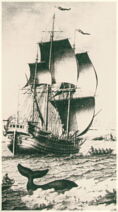
Whaling is the hunting of whales primarily for meat and oil. The species hunted in the Arctic Ocean was the Bowhead Whale, a baleen whale that yielded large quantities of oil and baleen. The whales entered the fjords in the spring following the breakup of the ice. They were spotted by the whalemen from suitable vantage points, and pursued. The whale was harpooned and lanced to death. It was either towed to the stern of the ship, or to the shore at low tide, where men with long knives would cut up the blubber. The blubber was boiled in large copper kettles and cooled in large wooden vessels, after which it was funneled into casks. The stations at first only consisted of tents of sail and crude furnaces, but were soon replaced by more permanent structures of wood and/or brick. 

Encouraged by reports of whales off the coast of Spitsbergen (Svalbard) in 1610, an English whaling expedition was send there the following year. The expedition was a disaster, with both ships sent being lost and the crews returning on another ship. The following year 2 more ships were sent. Other countries followed suit, with Amsterdam and San Sebastian each sending a ship north. The latter ship returned to Spain with a full cargo of oil. Such a fabulous return resulted in 1613 in a fleet of whaleships being sent to Spitsbergen. The English send 7 ships, backed by a monopoly charter granted by King James I. They met with 20 other whaleships, including 3 Dutch ships. 

Early in 1614 the Dutch formed the Noorsche Compagnie (Northern Company), a cartel composed of several independent chambers (each representing a particular port). In 1615 the Dutch arrived with a fleet of 11 ships and 3 men-of-war under Adriaen Block (±1567-1627). They built the 1st permanent structure on Spitsbergen: a wooden hut to store their equipment in. The following year, 1616, the English, with a fleet of 10 ships, occupied all the major harbors, appropriated the Dutch hut, and made a rich haul, while the Dutch, preoccupied with the isle of Jan Mayen, only sent 4 ships to Spitsbergen, which "kept together in odd places... and made a poor voyage". 

In 1619 the Dutch and Danes, who had sent their 1st whaling expedition to Spitsbergen in 1617, firmly settled themselves on Amsterdam Island, a small island on the northwestern tip of Spitsbergen, which came to be called "Smeerenburg". The English did the same in the fjords to the south. 
Beginning in the 1630s, for the Dutch at least, whaling expanded into the open sea. Gradually whaling in the open sea and along the ice floes to the west of Spitsbergen replaced bay whaling. At first the blubber was tried out at the end of the season at Smeerenburg, or elsewhere along the coast, but after mid-century the stations were abandoned entirely in favor of processing the blubber upon the return of the ship to port. The English meanwhile stuck resolutely to bay whaling, and didn't make the transfer to offshore whaling until long after.
One of my ancestors, Thomas Thomasz Brullee, was commander on the ship "D'Zee Egel" in 1687. The ship had trouble with leakage and broken pumps and returned without cargo. In 1712 Thomas was commander on the the ship "'t Dortse Lam" when the ship was attacked in the Arctic Ocean by French pirates who stole the cargo. Thomas is not a typical Dutch name; his ancestors may have originated in Great-Britain.