Feodor Vassilyev (±1707-1782) was a peasant from Shuya, Russia. His 1st wife (her name may have been Valentina) sets the record for most children birthed by a single woman. She gave birth to a total of 69 children. How did she do that? Well, she gave birth to 16 pairs of twins, 7 sets of triplets and 4 sets of quadruplets in the period 1725-1765 in a total of 27 births. An astounding 67 of the 69 children born are said to have survived infancy.
The French Academy of Sciences attempted to verify the claims about Vassilyev's children and contacted "M. Khanikoff of the Imperial Academy of St Petersburg for advice as to the means they should pursue, but were told by him that all investigation was superfluous, that members of the family still lived in Moscow and that they had been the object of favours from the Government". In the 1930s Julia Bell concluded that Vassilyev's case "must be regarded as under suspicion". Too good a story to be true?!
Recently my father's cousin, named Teun like my father, provided me with an old picture of my great grandmother on my father's side! Her name is Maaike van Driel. She was born in Strijen, South-Holland, on December 2, 1859, as the youngest, but only surviving daughter of Paulus van Driel (1812-87) and Barbara Hoogvliet (1816-89). In the winter of 1855-56 the 5 surviving children of this couple (Grietje, Maaike, Pieter, Willempje and Kornelis) had all died, likely from the prevailing cholera epidemic, or another infectious disease. At the age of 40, Barbara had no living children left, but she managed to give birth to 3 more children of whom her son Pieter reached the age of 30, and Maaike, my great grandmother, survived to old age.
Maaike van Driel (to the left) and her daughter Barbara ("Bet") Bos (to the right).
Maaike van Driel married my great grandfather Teunis ("Teun") Bos (1853-1923) on April 21, 1880, in Strijen, and they lived on the Keizersdijk in Cillaarshoek (nowadays part of Strijen). They had 11 children and 9 of them reached the age of maturity and married. One of Maaike's children was Barbara ("Bet") Bos (1894-1980, above to the right). She married Cornelis den Tuinder and had 2 sons. The photograph above was likely taken in the 1910s before Bet's marriage. In old age Maaike van Driel lived with her youngest son Hendrik ("Henk") Bos, my grandfather, and his family. My father, another Teunis ("Teun") Bos, still remembers his grandmother. Maaike was 76 years old when she died on January 24, 1936.
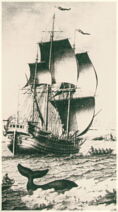
Whaling is the hunting of whales primarily for meat and oil. The species hunted in the Arctic Ocean was the Bowhead Whale, a baleen whale that yielded large quantities of oil and baleen. The whales entered the fjords in the spring following the breakup of the ice. They were spotted by the whalemen from suitable vantage points, and pursued. The whale was harpooned and lanced to death. It was either towed to the stern of the ship, or to the shore at low tide, where men with long knives would cut up the blubber. The blubber was boiled in large copper kettles and cooled in large wooden vessels, after which it was funneled into casks. The stations at first only consisted of tents of sail and crude furnaces, but were soon replaced by more permanent structures of wood and/or brick.
Encouraged by reports of whales off the coast of Spitsbergen (Svalbard) in 1610, an English whaling expedition was send there the following year. The expedition was a disaster, with both ships sent being lost and the crews returning on another ship. The following year 2 more ships were sent. Other countries followed suit, with Amsterdam and San Sebastian each sending a ship north. The latter ship returned to Spain with a full cargo of oil. Such a fabulous return resulted in 1613 in a fleet of whaleships being sent to Spitsbergen. The English send 7 ships, backed by a monopoly charter granted by King James I. They met with 20 other whaleships, including 3 Dutch ships.
Early in 1614 the Dutch formed the Noorsche Compagnie (Northern Company), a cartel composed of several independent chambers (each representing a particular port). In 1615 the Dutch arrived with a fleet of 11 ships and 3 men-of-war under Adriaen Block (±1567-1627). They built the 1st permanent structure on Spitsbergen: a wooden hut to store their equipment in. The following year, 1616, the English, with a fleet of 10 ships, occupied all the major harbors, appropriated the Dutch hut, and made a rich haul, while the Dutch, preoccupied with the isle of Jan Mayen, only sent 4 ships to Spitsbergen, which "kept together in odd places... and made a poor voyage".
In 1619 the Dutch and Danes, who had sent their 1st whaling expedition to Spitsbergen in 1617, firmly settled themselves on Amsterdam Island, a small island on the northwestern tip of Spitsbergen, which came to be called "Smeerenburg". The English did the same in the fjords to the south. Beginning in the 1630s, for the Dutch at least, whaling expanded into the open sea. Gradually whaling in the open sea and along the ice floes to the west of Spitsbergen replaced bay whaling. At first the blubber was tried out at the end of the season at Smeerenburg, or elsewhere along the coast, but after mid-century the stations were abandoned entirely in favor of processing the blubber upon the return of the ship to port. The English meanwhile stuck resolutely to bay whaling, and didn't make the transfer to offshore whaling until long after.
One of my ancestors, Thomas Thomasz Brullee, was commander on the ship "D'Zee Egel" in 1687. The ship had trouble with leakage and broken pumps and returned without cargo. In 1712 Thomas was commander on the the ship "'t Dortse Lam" when the ship was attacked in the Arctic Ocean by French pirates who stole the cargo. Thomas is not a typical Dutch name; his ancestors may have originated in Great-Britain.